Ray Fox Ray Fox
0 Course Enrolled • 0 Course CompletedBiography
Pass Guaranteed AVIXA Marvelous CTS - Certified Technology Specialist Boot Camp
The CTS PDF Questions of Exam-Killer are authentic and real. These Certified Technology Specialist (CTS) exam questions help applicants prepare well prior to entering the actual Certified Technology Specialist (CTS) exam center. Due to our actual CTS Exam Dumps, our valued customers always pass their AVIXA CTS exam on the very first try hence, saving their precious time and money too.
AVIXA CTS - General Exam Syllabus Topics:
| Topic | Weight |
|---|---|
| Duty A:Creating AV Solutions | 47% |
| Task 1:Gather Customer Information | 10% |
| Task 2:Conduct Initial Site Survey | 9% |
| Task 3: Evaluate Site Environment (acoustics, lighting, seating, finishing, etc.) | 9% |
| Task 4:Develop an AV Project Scope | 9% |
| Task 5: Design AV Solutions | 10% |
| Domain 2:Implementing AV Solutions | 27% |
| Task 1:Integrate AV Solutions | 10% |
| Task 2:Operate AV Solutions | 9% |
| Task 3:Manage AV Projects | 8% |
CTS Flexible Learning Mode - Latest CTS Exam Materials
You can study CTS exam engine anytime and anyplace for the convenience our three versions of our CTS study questions bring. What is more, it is our mission to help you pass the exam. Our study materials will provide you with 100% assurance of passing the professional qualification CTS Exam. We are very confident in the quality of CTS guide dumps. Our pass rate is high as 98% to 100%. You can totally rely on us.
AVIXA Certified Technology Specialist Sample Questions (Q121-Q126):
NEW QUESTION # 121
Which section of the Ohm's Law chart should be used to calculate values expressed in Ohms? Select the answer by clicking anywhere within the correct quadrant.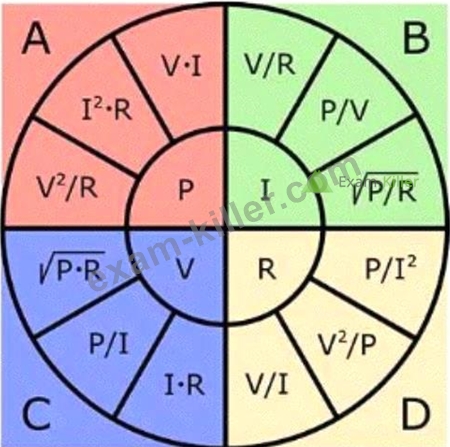
Answer:
Explanation: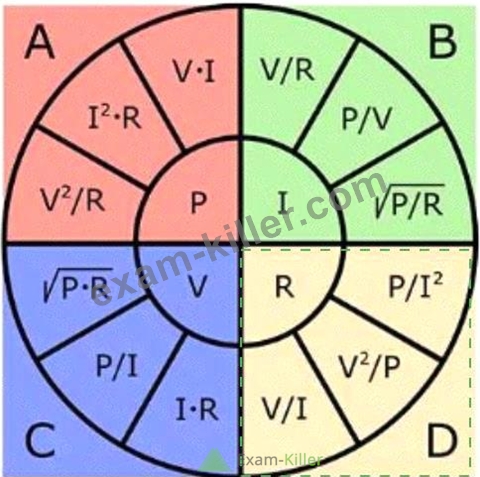
Explanation:
Ohm's Law is a fundamental principle used in electrical engineering and physics to describe the relationship between voltage (V), current (I), resistance (R), and power (P). The Ohm's Law chart is divided into four quadrants, each representing different formulas and relationships among these quantities.
To calculate values expressed in Ohms (which represent resistance, R), you should use Quadrant D. This quadrant contains formulas that solve for resistance (R), using various combinations of voltage (V), current (I), and power (P):
* R=VIR = rac{V}{I}R=IV
* R=V2PR = rac{V